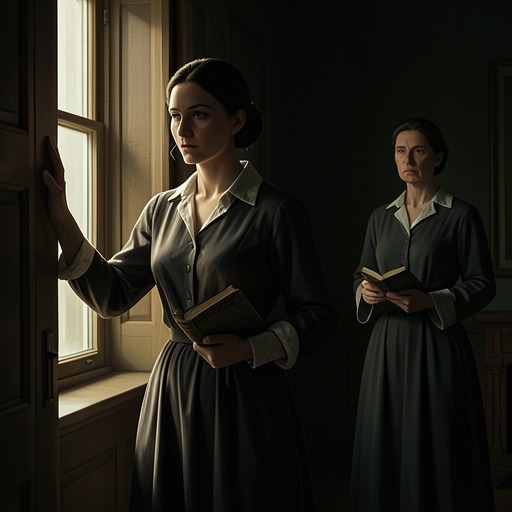
Arranged engagement
My Vampire Love (Completed)Arranged engagement is the forced marital bond established between Jenifer Kate Lawrence and Eric Wilson before either of them can freely define their relationship. Presented first as a debt owed for Jenifer’s survival, it turns her life into the collateral for an agreement made at her birth. As the hidden medical and supernatural circumstances emerge, the engagement becomes more than a family secret: it is the mechanism through which Jenifer’s body, future awakening, sexuality, and potential children are placed inside a struggle over vampire power.
Origin in a Life-Saving Bargain
The engagement is revealed in Jenifer’s parents’ living room, where Eric’s parents appear as outsiders in the ordinary domestic space. Jenifer learns that she has been engaged to Eric since birth, although she has never been told. The arrangement originated when Dr. Wilson helped keep her alive on the condition that, when she reached seventeen, she would marry his son if Eric chose to do so. The Wilson family has supplied the medication that sustained her from infancy, making treatment inseparable from an obligation imposed on her family.
The bargain leaves Jenifer facing a deliberately narrowed choice: death at birth or marriage to a stranger whom she might hate for the rest of her life. Her parents insist that they had no alternative because they could not let her die, but the explanation does not restore the years of consent and knowledge taken from her. The transaction therefore has two simultaneous meanings. From the parents’ perspective, it is a desperate exchange of medical help for survival; from Jenifer’s perspective, it is a life sentence concealed beneath her treatment.
Discovery and Immediate Resistance
Jenifer’s first response is not simple anger but emotional blankness. She recognizes that she ought to be furious, yet the revelation initially reaches her through coldness, bodily tightening, a rising lump in her throat, and difficulty breathing. The disclosure collides with an already severe emotional crisis: for almost three weeks after another devastating night, she has survived by refusing to speak and by hiding inside numbness. Not talking is described as the only method she knows for keeping the pain from becoming fatal to her, so the engagement revelation breaks through a defense that had been holding her together.
When her parents repeat that Dr. Wilson made her strong enough to survive and that they owe him everything, Jenifer’s grief becomes open accusation. She tells her mother that the family has kept her in the dark and lied to her entire life. Eric confirms that he has known about the engagement since birth, intensifying her sense that everyone has participated in a future decided without her. She concludes that everyone knew about her wedding except her and threatens to make married life hell. At the doorway, she returns Eric’s earlier hostility by telling him that he was right about her hatred and congratulating him on the engagement without affection.
Her refusal is later expressed through her treatment itself. Jenifer understands that the small brown pills are keeping her alive, yet she considers death an escape from pain, guilt, and heartbreak. In one deliberate act of resistance, she removes three pills from the bottle, watches them dissolve into a faint pinkish-red stain in the toilet, flushes them away, and lies to Eric that she is fine. The engagement thus becomes entangled with a dangerous refusal of the medical system that supports her life: rejecting the pills is both an attempt to reclaim control and an act that threatens to make the original bargain’s coercive alternative real.
The Wedding as an Imposed Future
Eric later tells Jenifer that his parents will not postpone the wedding. The invitations have already been sent, the venue chosen, and just over a month remains. The practical details make the arrangement more oppressive than an abstract promise: the dress, cake, and other decisions have been made or anticipated without Jenifer’s participation. She realizes that her life has been decided around her and that the engagement is not merely a possibility but an organized future already moving toward completion.
The arrangement also alters Eric’s conduct. After Jenifer faints, he watches her closely because he knows that her health makes the episode abnormal, even though he does not yet understand the full nature of her condition. She explains that she has always been sick, that fainting, vomiting, and unexplained nosebleeds are part of her life, and that the medication makes her appear like everyone else. Her disclosure identifies aplastic anemia as the bodily reality beneath the engagement: her bone marrow cannot produce red blood cells, white blood cells, or platelets, so without the pills she could die from an ordinary infection or bleed from an otherwise nonfatal wound.
The engagement consequently places Jenifer in a cruel contradiction. The treatment that keeps her alive was supplied through the same family structure that claims authority over her marriage. Her illness is treated as something that must be managed, concealed, and made useful, while her apparent survival is used to justify removing her freedom. The narrative gives the medical condition concrete daily consequences rather than presenting it only as a symbol: medication is taken or destroyed, physical weakness interrupts movement, and the prospect of death remains immediate.
Blood, Experiment, and Vampire Succession
The supernatural meaning of the engagement is disclosed when Eric explains that Jenifer’s medication is actually his blood, confined in a weaker form. It has healed her and kept her alive without yet transforming her. Earlier, Jenifer had consumed a much larger amount of vampire blood through Katalin’s intervention; that stronger dose eventually intensified her emotions and physical responses. The contrast between the pills and the transfusion clarifies that her survival has always depended on a controlled circulation of Eric’s blood.
Eric identifies Jenifer as the only living subject of an attempt to create a true pureblood vampire from a human. The experiment was developed because the vampires hold the ruling position among supernatural species, but their power could shift to witches, shifters, or another group. Since purebloods are scarce, vampire authorities sought a way to manufacture more of them and preserve their supremacy. Earlier attempts killed the human subjects, transformed them into made vampires, caused comas, or produced zombie-like results when the amount or timing of blood was wrong.
The experimental breakthrough depended on Jenifer’s aplastic anemia. Because her body cannot create blood cells, the researchers hoped that vampire blood would supply the material from which a new blood system could develop. Attempts involving pregnant mothers had produced hybrids, but a newborn unable to produce any blood cells offered a different possibility. Jenifer’s illness therefore saved her life through the medication while also making her the ideal experimental body. She is simultaneously the most endangered human and the most protected one: vulnerable because her survival depends on treatment, protected because the vampire hierarchy needs her alive.
The arrangement is tied to the approaching eighteenth birthday, when pureblood vampire blood awakens. Eric explains that before that age the blood remains dormant and its bearer can appear human; afterward it can make the body stronger, faster, and otherwise transformed. Jenifer understands that she is expected to awaken as well. Eric says the marriage must occur before that awakening and links their future child to the production of an even purer and stronger bloodline. In this logic, marriage is not primarily an intimate promise. It is a reproductive instrument for maintaining a species at the top of the food chain.
From Coercion to Emotional Reinterpretation
The engagement’s meaning changes as Jenifer learns that Eric is not merely the heir to a family bargain but the source of the blood sustaining her. His explanation does not erase the coercion, but it reframes the relationship’s stakes. He tells her that she is someone rather than something and calls her the most important person there is. That distinction directly opposes the language of the experiment, which has reduced her to a successful subject and a possible means of producing stronger purebloods.
Jenifer’s feelings toward Eric move through refusal, suspicion, proximity, and attachment rather than changing at the moment of the announcement. At first she sees the engagement as imprisonment and promises to make the marriage unbearable. Later, his concern over her fainting and his attentiveness to her illness reveal a more personal involvement, even though his knowledge is partial and his family’s control remains intact. The bond therefore follows a romance pattern built on resistance: the imposed relationship begins as an arrangement she rejects, while emotional intimacy develops under conditions that make genuine consent difficult to separate from dependence.
The final tension is ethical as well as romantic. Jenifer’s body is treated as a site of medical rescue, vampire inheritance, and reproductive planning, yet her struggle repeatedly returns to whether she can remain a person within those systems. When her prematurely awakened vampire side begins killing her, she fights to force herself back into human consciousness because she refuses to let another person die for her. That act does not resolve the engagement’s institutional violence, but it demonstrates a form of agency different from both submission and self-destruction: Jenifer chooses survival while resisting the instinct and power that have been imposed upon her.
Narrative Significance
The arranged engagement concentrates the story’s central conflict between life and autonomy. Jenifer survives because the Wilson family’s blood and medication enter her body, but the same exchange produces a debt that others attempt to collect through marriage. Her illness is therefore not simply a private medical condition; it is the point at which family obligation, supernatural hierarchy, experimental science, and romantic expectation converge.
The engagement also exposes how apparently protective actions can become instruments of control. Jenifer’s parents preserve her life yet conceal the price. Dr. Wilson provides treatment yet establishes the condition. Eric inherits knowledge of the arrangement and eventually presents its supernatural rationale, while the wedding machinery advances through invitations and a chosen venue before Jenifer has any meaningful say. The language of protection thus repeatedly borders on possession.
By connecting the engagement to Jenifer’s eighteenth-birthday awakening and to the prospect of a future pureblood child, the narrative expands a private forced marriage into a political project. What begins as a hidden promise between families becomes part of a species-wide attempt to secure power. Its decisive contradiction remains unresolved within the arrangement itself: Jenifer is valued precisely because she is treated as irreplaceable, but that value is repeatedly expressed through the denial of her independence. The engagement matters because every later revelation forces the same question into sharper focus—whether a life preserved through another person’s control can still become a life chosen by its survivor.